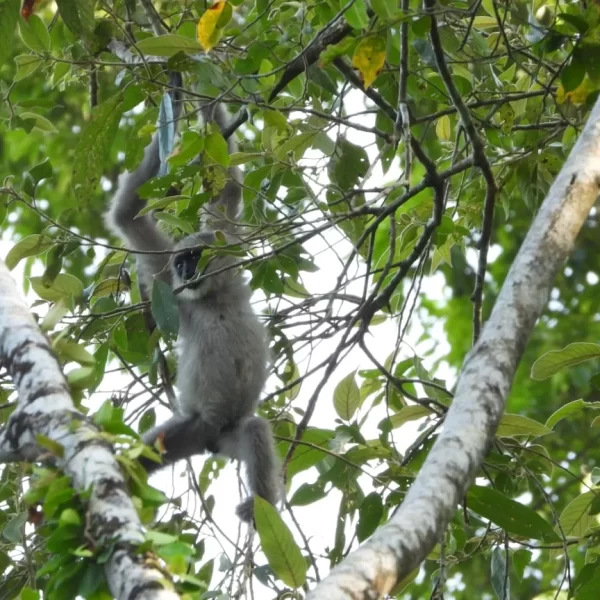
Javan Gibbon Watching Tour at Ujung Kulon National Park. The Javan gibbon (Hylobates moloch) is a species of gibbon, a small ape, found on the island of Java in Indonesia. It is one of the most endangered primate species in the world. Here are some key characteristics and information about the Javan gibbon: Owa Jawa Taman Nasional Ujung Kulon
Tour Duration : 4 Days / 3 Night2
Transportation Chartered Car, Wooden Boat Accommodation : 1 Night Fauna Lodge, 2 nights Camping
Start / Finish Jakarta
Trip Grade : Easy to Moderate
Tour Organizer: tour guide
Price / Person Contact Us
Javan Gibbon javan gibbon Appearance Javan gibbons are small apes with long, slender arms and no tail. They have black fur with a white fringe of hair surrounding their face, which gives them a distinctive appearance. Size Adult Javan gibbons typically weigh around 5 to 7 kilograms (11 to 15 pounds) and have a body length of about 44 to 60 centimeters (17 to 24 inches). Males and females are similar in size. Habitat These gibbons are primarily found in lowland and montane rainforests on the island of Java in Indonesia.
They prefer living in the upper canopy layers of the forest. Behavior Javan gibbons are highly arboreal, spending most of their time in trees. They are known for their agile and acrobatic movements, using their long arms to swing and brachiate from branch to branch. They are diurnal (active during the day) and have loud vocalizations that help them communicate with other members of their group. Social Structure Javan gibbons are monogamous and usually form small family groups consisting of an adult mating pair and their offspring. They are highly territorial, and their loud calls help them defend their territory and communicate with neighboring groups.
The female will produce offspring every 2 to 3 years, with a gestation period of 7-8 months. Javan gibbon infants will stay within the group until they are fully sexually mature and then leave to form their own families. If there is a threat in their area, female gibbons will issue an alarm call as a sign of danger. Diet Their diet mainly consists of fruits, leaves, flowers, and occasionally small insects.
They are important seed dispersers in their ecosystem, aiding in the maintenance and regeneration of forests. Conservation Status The Javan gibbon is listed as critically endangered on the IUCN Red List of Threatened Species. The major threats to their survival include habitat loss due to deforestation, illegal logging, and land conversion for agriculture. They are also threatened by hunting and the illegal pet trade. Conservation efforts are crucial for the survival of the Javan gibbon, focusing on protecting their habitat, preventing illegal hunting and trade, and raising awareness about their critical status.
Currently, the distribution of Javan gibbons is limited to national parks and protected forests in West Java and Central Java, especially in Gunung Halimun-Salak National Park, Gunung Gede Pangrango National Park, Ujung Kulon National Park, Gunung Simpang, Leuweung Sancang, Gunung Papandayan, and Gunung Tilu. Specifically, the habitat of Javan gibbons is tropical forests, ranging from lowlands to mountains, at elevations of 0-1,600 meters above sea level. Tropical rainforests below 1,500 meters above sea level are an exclusive habitat for Javan gibbons. They rarely come down to the ground and spend most of their time in the upper canopy of trees, depending on trees for protection and food sources. The highest percentage of their diet consists of ripe fruits (61%), followed by leaves (38%), and flowers (1%). Fruits are the main food source for Javan gibbons compared to other parts of the food tree. However, they are also known to consume young leaves, shoots, flowers, and some invertebrates.